
How One Maker and Two Robots Build Civic Monuments: The nioform (Sweden) Case Study
Categories: Blog

A One-Man Workshop Behind Public-Scale Projects
In an old warehouse hangar on the shore of Lake Vänern — no signage, almost incognito — there’s a workshop where small models turn into full-scale monuments, theme-park elements, and cinematic “troll skulls.” The workshop is run by one person: Joakim Målare. He takes a sketch, a scan, or just an idea and drives it all the way to finished molds and assembly kits for foundries and installation crews. His trademark move for one-off pieces is to mill the negative directly, skipping the “positive → mold” step — saving weeks and avoiding the errors that come with hand fitting. The pipeline connects design and construction in a single loop so that 3D models become material structure with production-grade accuracy and predictable cost.
From Art School and Stone to Robots and “Clean” Geometry
Målare’s path wasn’t linear: 3D graphics since the late ’90s, foundational art training, model-making (including full-scale “clay” in automotive design), then eight years in stone, where he learned to program machines and to value the hybrid approach — “machine + hand” — at the finish. Today his focus is public art and small architectural forms—one-off large objects where digital modeling connects straight to fabrication. Artists, an architect, and a fabricator can work from the same geometry, keeping planning and creation tightly aligned from concept to install.
The Production Setup
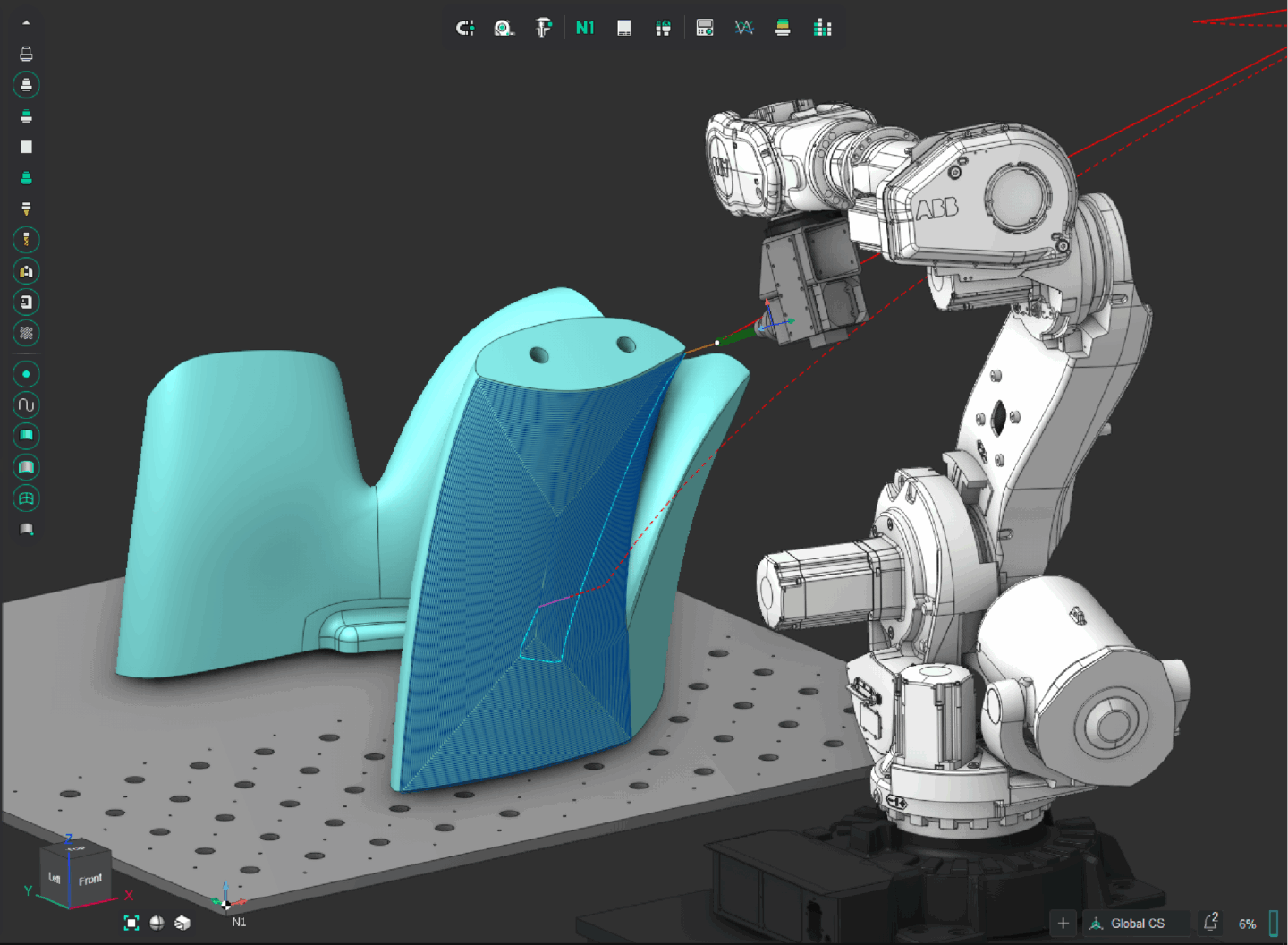
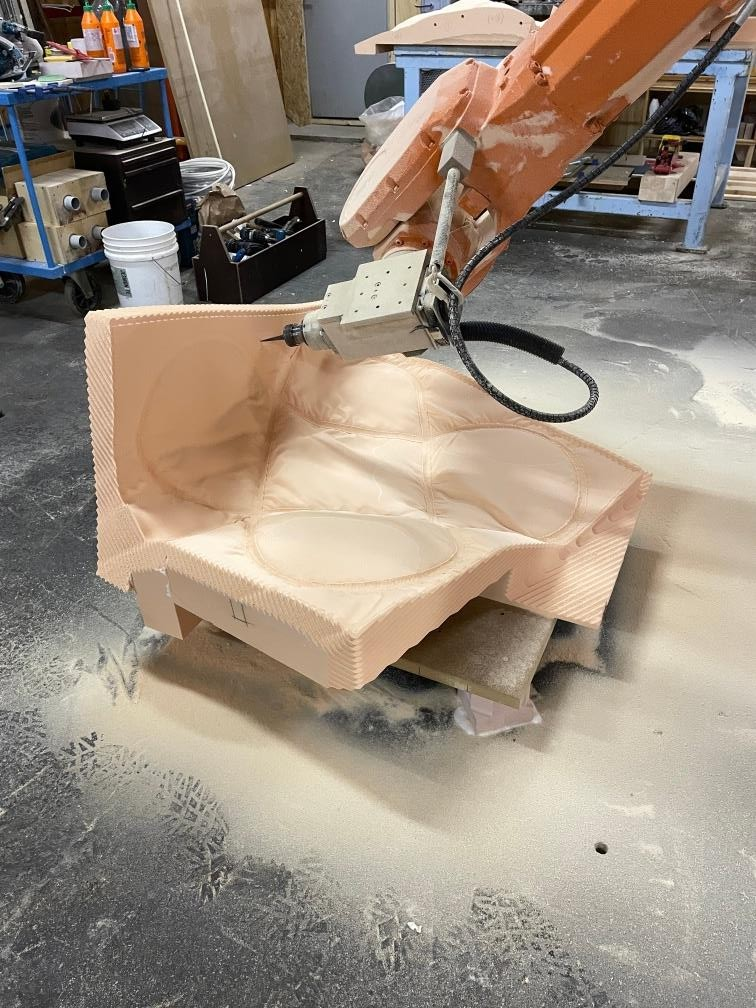
Two secondhand industrial robots, a fixed table, a rotary table (positioner), and rail-mounted fixtures for horizontal setups. The hardware is unassuming: an old gaming PC with enough memory; toolpath calculations in ENCY — a CAD/CAM system by ENCY Software — typically complete in tens of seconds, so it’s comfortable to work. For 3D capture he uses an H2 scanner; meshes, 3D models, and solids go through Blender and Plasticity; setup planning happens in Rhino; programming is done in ENCY 5X Mill with the Robot module — an offline programming (OLP) solution for industrial robots — so he can prep jobs both for his robots and for traditional CNC. Data can be exchanged with other architecture and construction teams. It’s a compact, modern cell whose capability comes from technology — not size.
Digital-to-Physical: Shop-Floor Stories
Theme parks: the “banana” slide and composites that click together on the first try
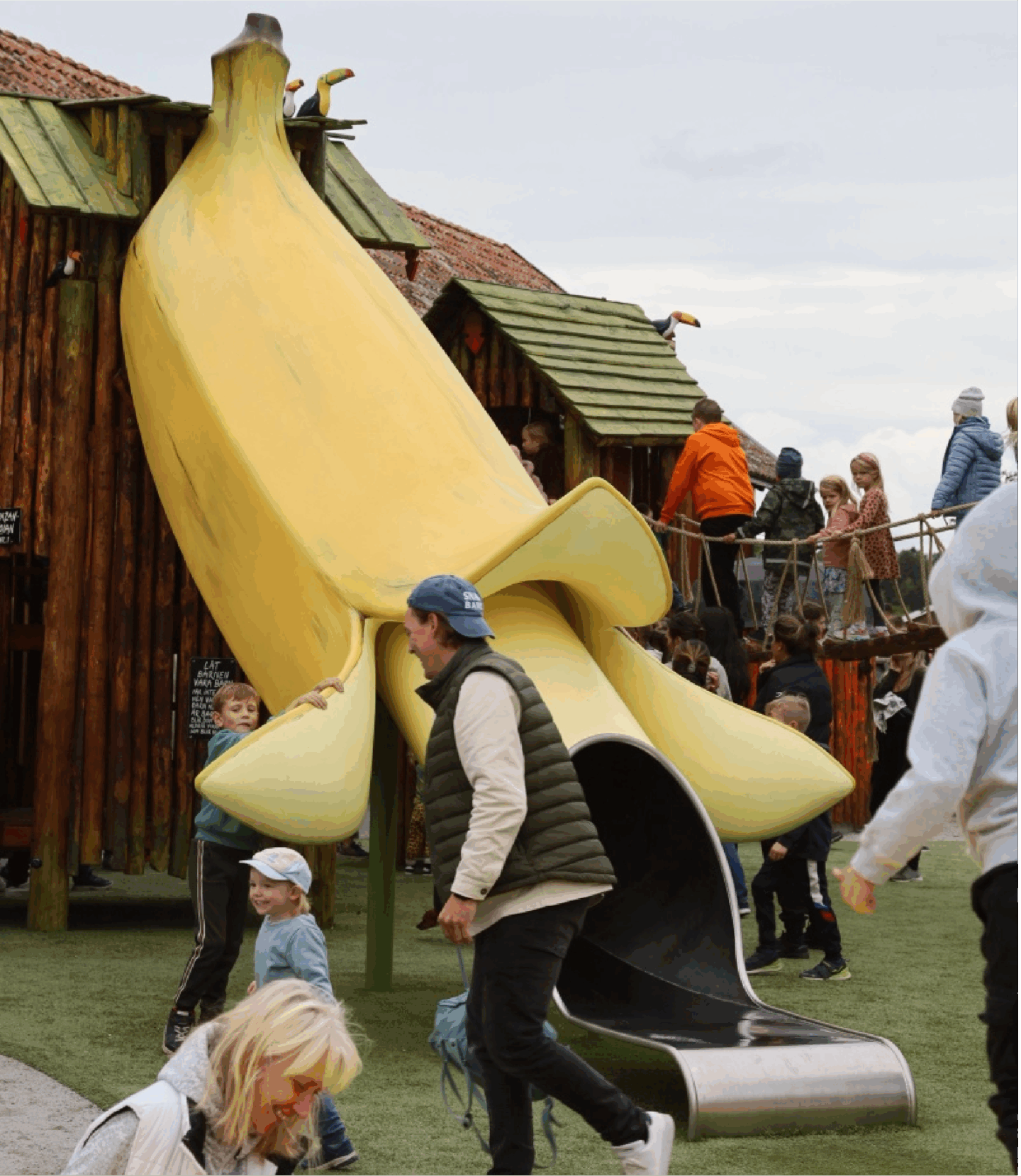
The client shows up with an almost childlike sketch: “Here’s a banana — turn it into a slide.” The steel tubing and the fiberglass “peel” go to different contractors, but everyone stays locked to the same digital geometry. Big volumes are cut from polystyrene foam; the excess gets burned off with a hot wire cutter; five-axis finishing lays down clean surfaces for the fiberglass skin. On site the “peel” drops onto the steel with no shimming — and you can hear the surprise even over the screw guns: “We didn’t think it would go together this easily.” The material behaves perfectly outdoors: durable, repairable, and practically unlimited in scale — the only questions are smart block partitioning and interfaces designed up front.
Film: a 3×3×4 m troll skull — when “roughing” is unnecessary
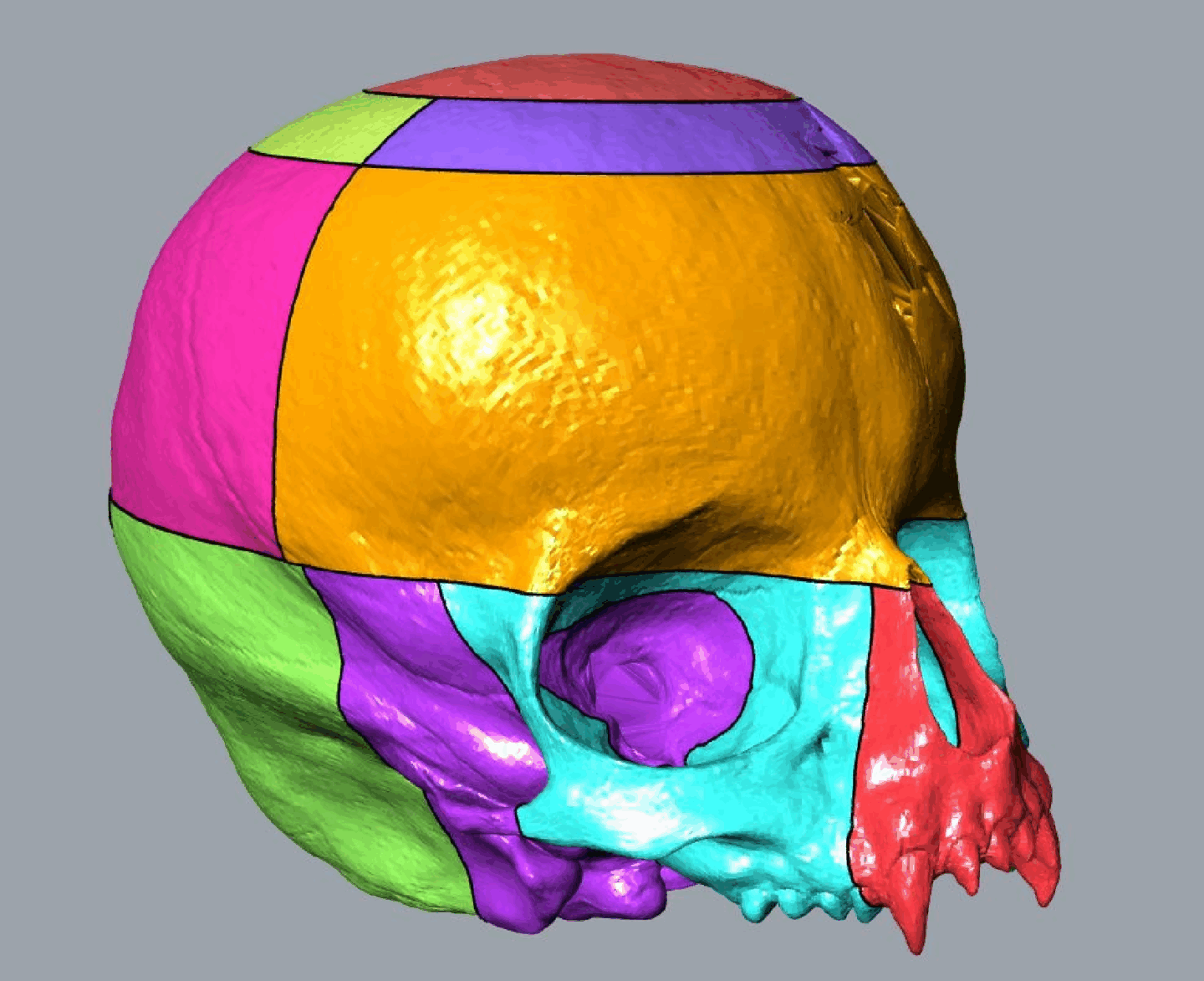
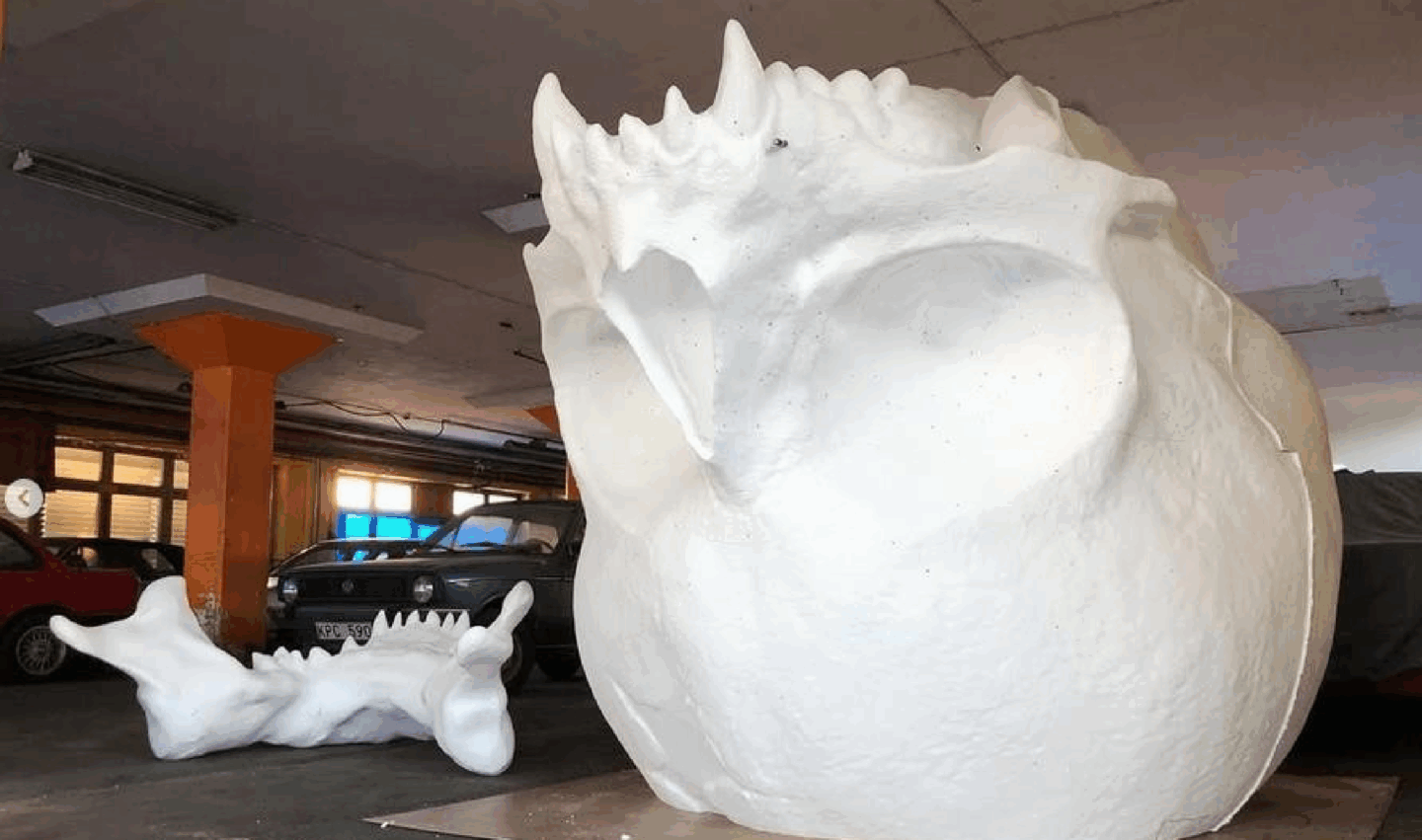
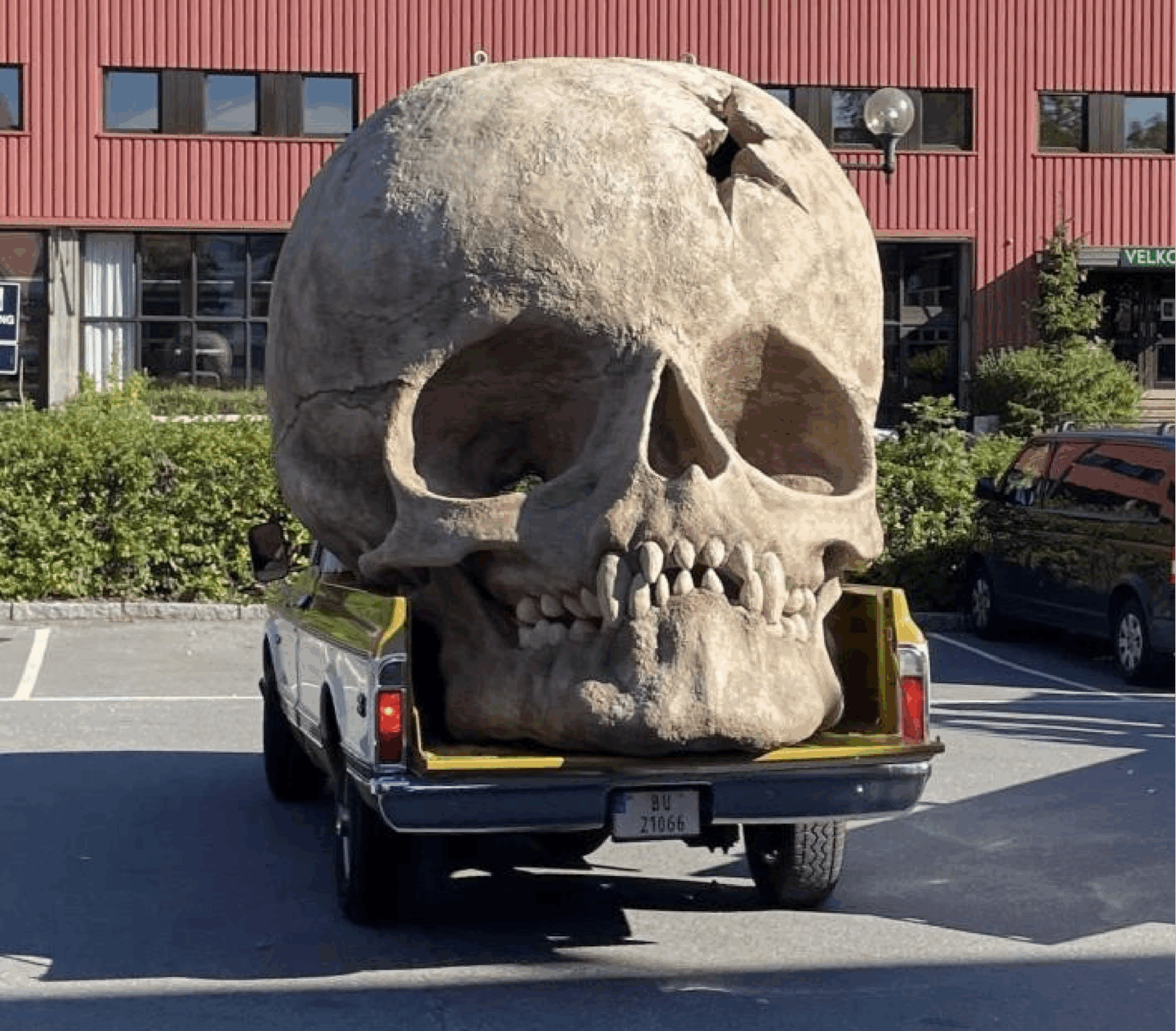
A one-week brief for a Norwegian production: a lifelike troll skull at full size — about 3×3×4 m, with elements larger than the robot itself. The team’s ask: leave the milling “toothy,” because primer, paint, and texture come later. The main headache is reachability and collisions in tight cavities where the tool doesn’t want to go. The move feels a bit audacious, but it works: burn out the excess with a hot wire to open “corridors” for the tool, then go straight to finishing — no separate roughing pass. In foam that’s not only safe, it radically compresses the schedule: time goes into the surface the camera will actually see, not into hauling away tons of chips. The “blank” hit the deadline without drama, with controlled geometry all the way down into the hollows.
“External tools”: a faceted lamp without a rotary
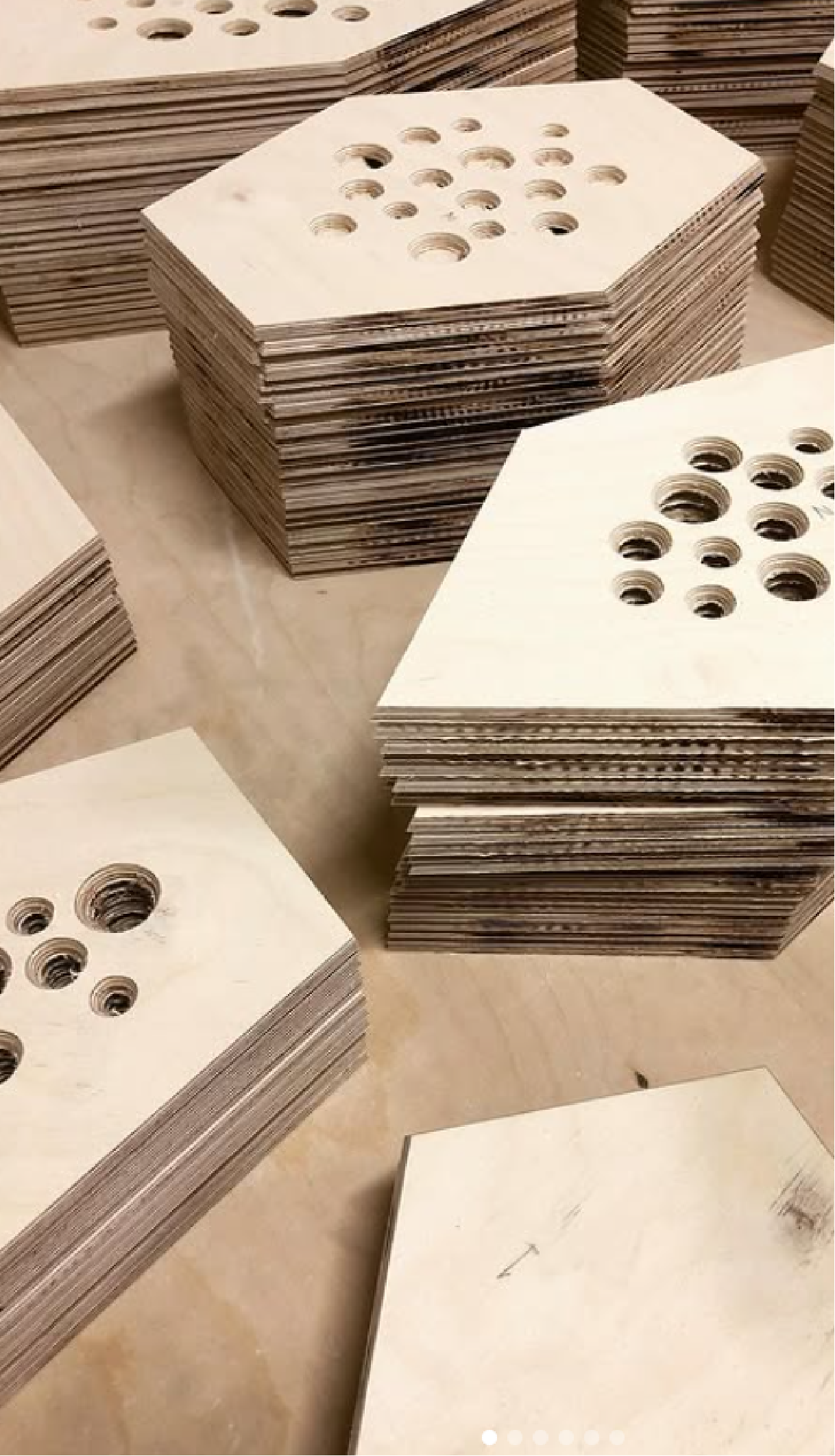
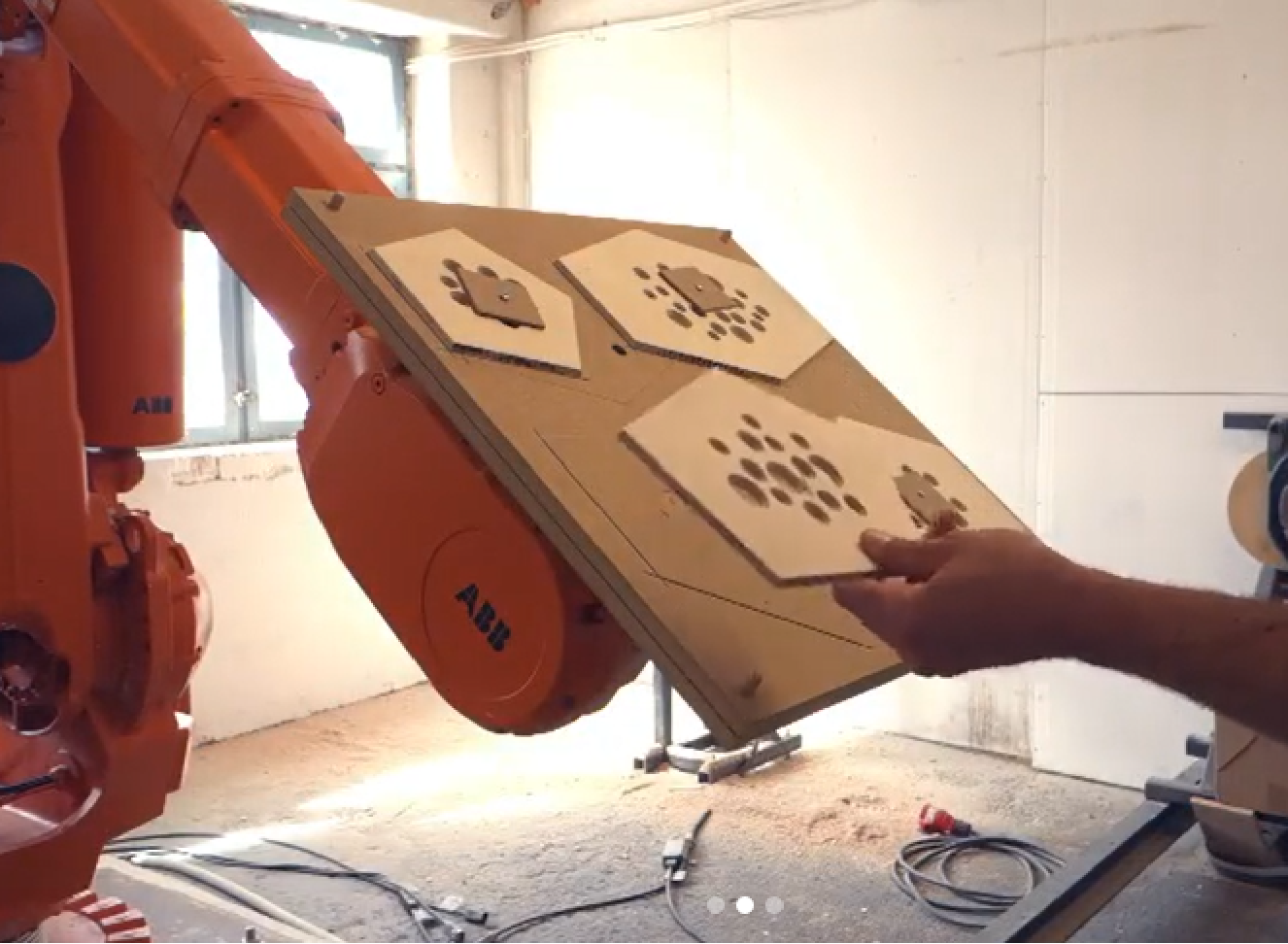
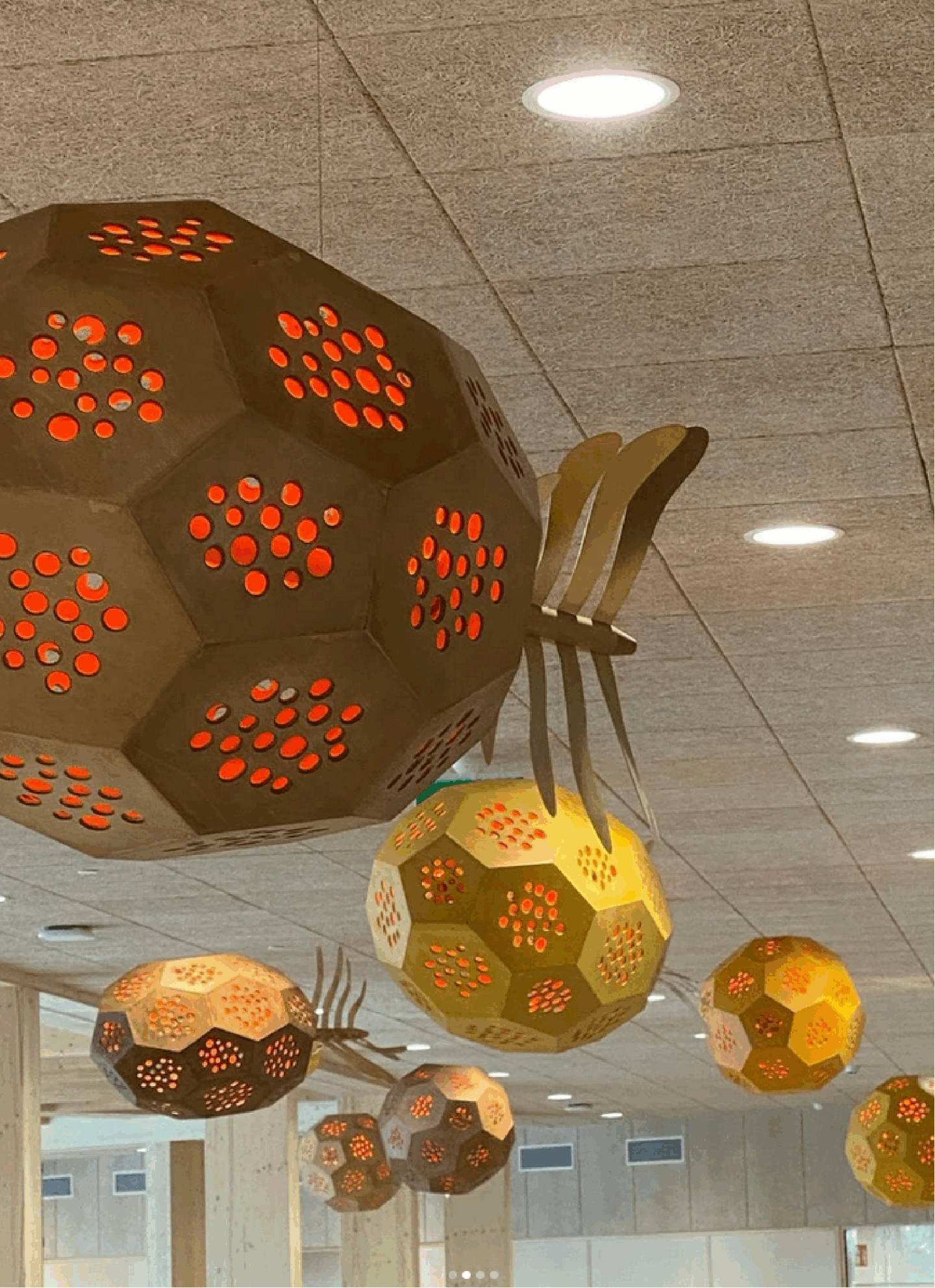
Two plywood halves of a faceted lamp have to meet on sharp planes so the edges “kiss” with no gaps. There’s no rotary — and there’s no need. The sheet is clamped to the robot; the spindle sits on the floor as an external tool. From there it’s a sequence of indexed 2D contours at deliberate angles, with the robot’s sixth axis doing the flipping and reorientation. The result is “five-axis” quality for the price of a couple of shop jigs: crisp edges, repeatable angles, and zero accumulated error from refixturing — an inverse-kinematics approach that shows what small cells can do in industry practice.
Casting “with wall thickness from the model”: an aluminum apple with the right inside
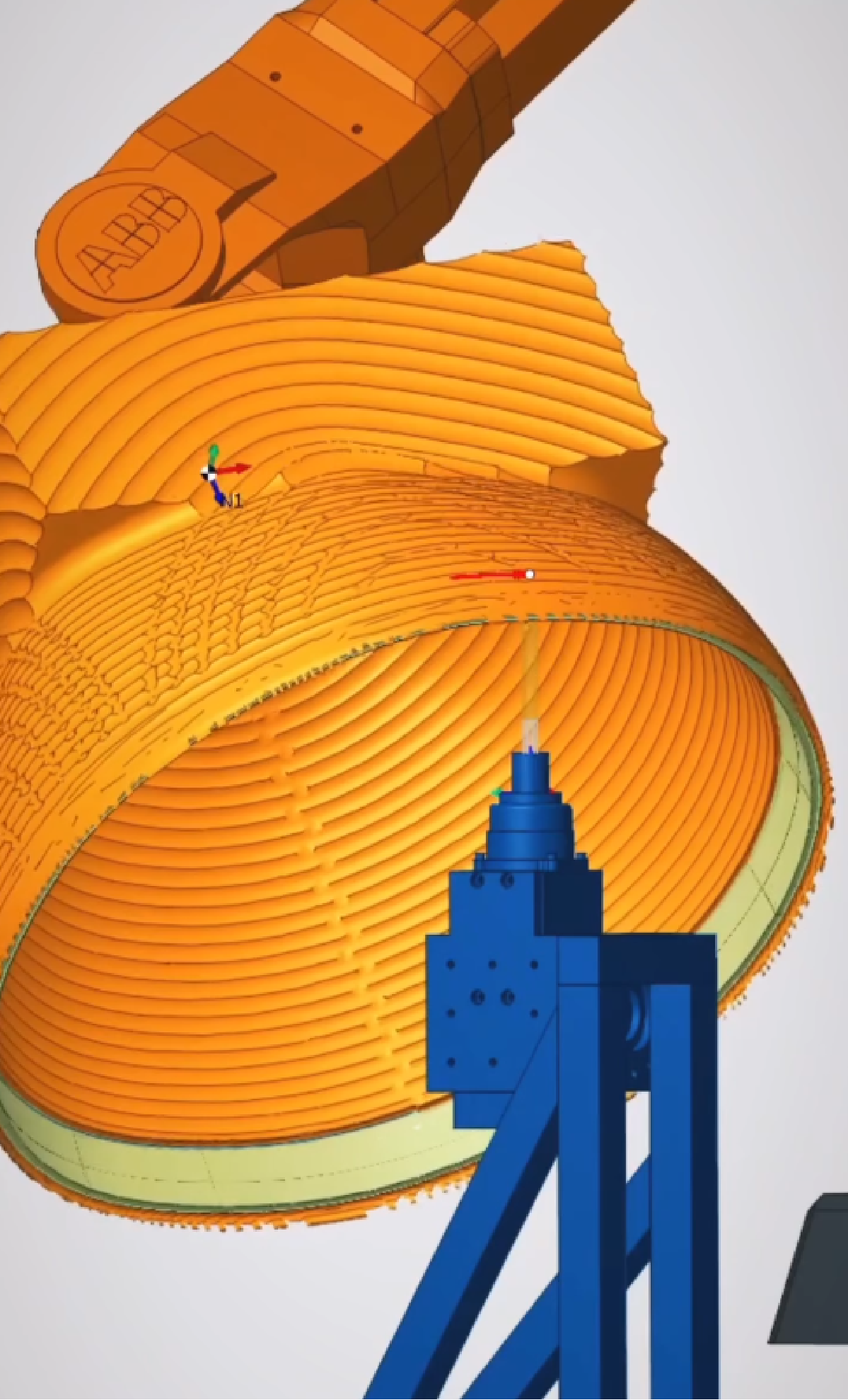
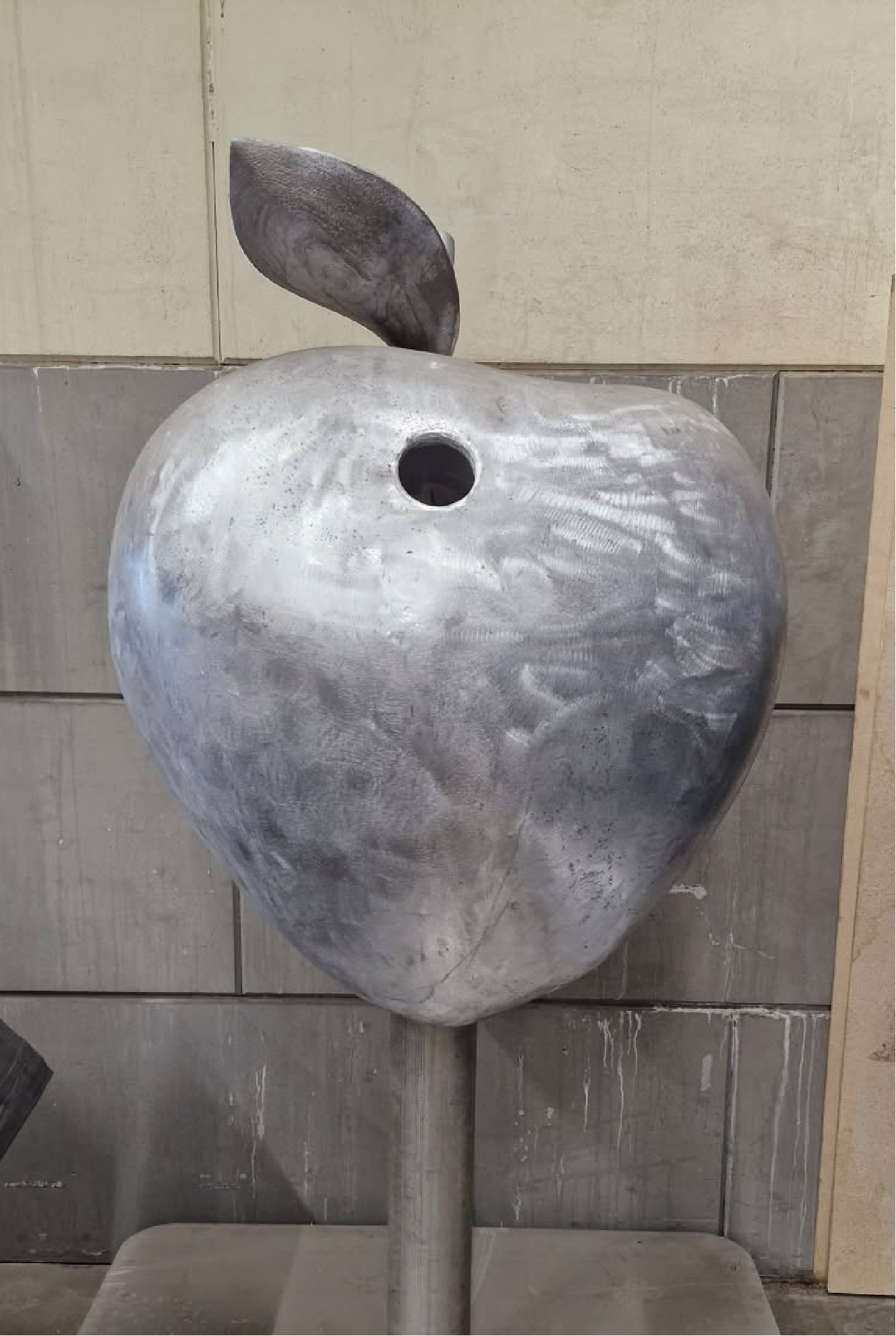
Normally you mill the outside and let the foundry “invent” the wall thickness later. Here the choice is the opposite: engineer the inside as meticulously as the outside so the model already reflects the final wall. The apple — leaves and stem included — uses the same external-tool approach: tidy inverse kinematics instead of elaborate hardware. The foundry receives geometry, not hints — which means fewer iterations and a clean shot at a first-time pour: a small but real technological advance in low-volume casting capability.
“Routing” for a wood sculptor: the machine makes the volume, the hand brings the voice
A sculptor used to clay and bronze wants to move into wood — without months of heavy roughing. The robot takes the bulk: indexed roughing and semi-finishing, carefully organized setups on a simple manual stand instead of a rotary. Then comes a deliberate 2 mm allowance: the artist picks up a gouge and brings back the expressiveness the work is about. The outcome is that same “this is mine” look, minus the exhausting grunt work — a digital-to-physical solution that keeps authorship intact.
Stockholm memorial: a “soft blanket” of poetry — digital fabric cast in bronze

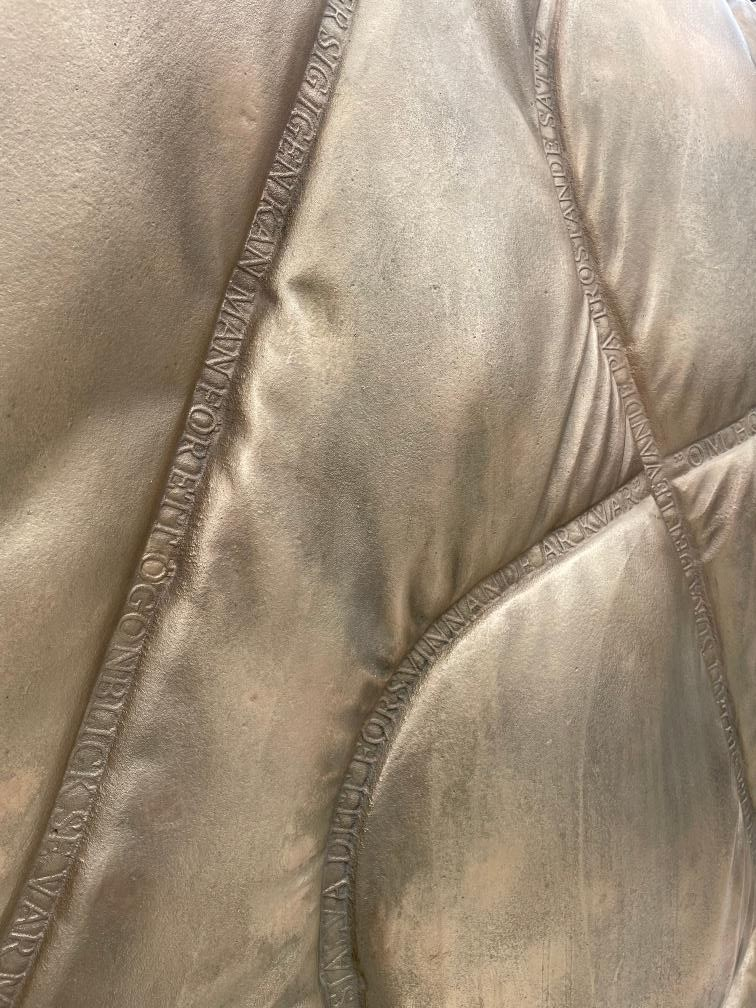
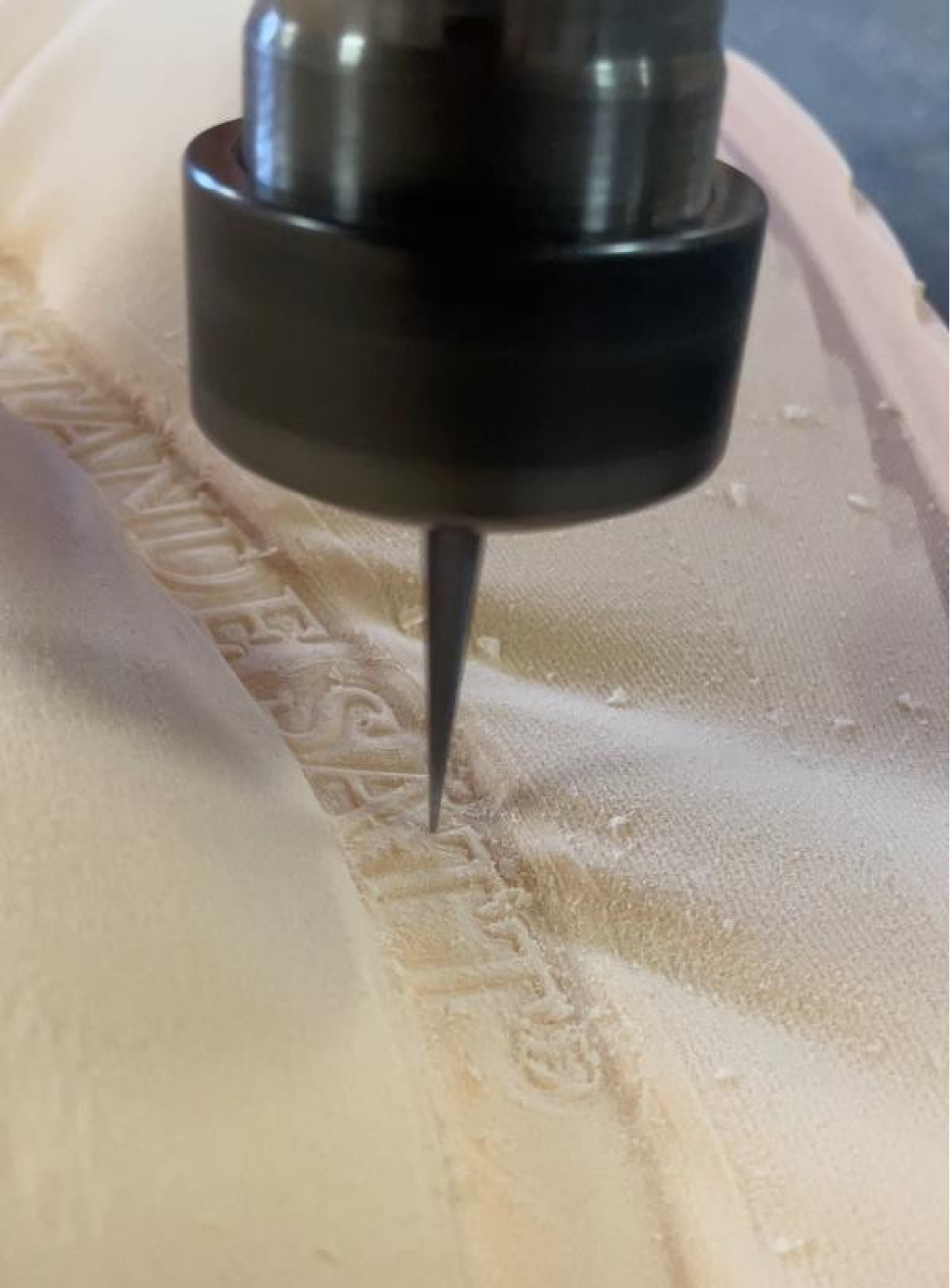
The artists’ idea is a large piece of quilted cloth with embroidered verse commemorating the events of 2017, cast in bronze. The text runs to dozens of lines, with letters only 17–18 mm high; a sand mold taken from a “soft” original will collapse, so the foundry needs a rigid master. Målare spreads the cloth on a frame and scans it — wrinkles and all — then gently adjusts the volume in the digital model and mills a polyurethane hard copy. The text is built entirely digitally: a Blender script generates each letter as its own mesh with a slightly “puffy” stitched profile, so CAM can run toolpaths around every character without smearing the microrelief. It’s a pure paradox: to preserve the feel of fabric, the process has to be as “hard” as possible, with control over every line of the type. The project took a couple of years, and the “bronze blanket” became a recognizable point of attraction with a warm public reception.
What Joakim Says About ENCY
“After five years working in ENCY, digital modeling for me is fully tied to the physical world. Any production method I can dream up is something I can actually execute thanks to MachineMaker, zero-code digital twin builder for CNC machines and robotic cells, and the open postprocessor generator. It gives me the confidence to try new combinations of materials — honestly, I wouldn’t be here today without ENCY.”
“The key advantage for me is the freedom to mix polygonal meshes and NURBS, to declare anything I want as the ‘part’ for a given operation, and to keep the stock as I go. I can drop in limiting geometry to route around clamps and fasteners without pain. And there’s a smooth handoff across setups and machines: I save the simulation from one robot as my new stock and continue on another.”
“On my, let’s say, not-so-new PC, calculations in ENCY usually take under 30 seconds — it’s comfortable to work.”

What Changes When “One Person and Two Robots” Becomes Normal
Schedules and predictability. “Direct digital negatives” and treating “simulation as stock” across setups remove weeks of hand fitting and minimize surprises at the “art ↔ fabrication” handoff. That flows straight into municipal timelines, film shoots, architecture briefs, and theme-park openings: fewer buffers, more confidence in hitting dates.
Democratized equipment. Second-hand robots, external tools instead of expensive fixtures, and programming in ENCY 5X Mill with a Robot module let small shops take on large-scale commissions without factory-level capital expenditure — lowering cost and widening access across the industry. The barrier to entry drops for independent workshops and regional ateliers.
Quality where the eye actually looks. Driving toolpaths around each letter and treating characters as separate meshes yields tangible micro-relief after casting — not over-engineering for its own sake, but a way to preserve the artist’s idea in material on the first try.
New roles for craft. Digital roughing/semi-finishing with a deliberate allowance hands the final touch back to the artist. The machine delivers volume and fit; the human delivers expression — an architectural mindset applied to fabrication.
Hybrid supply chains. When every contractor works from the same geometry, distributing production across shops stops being a risk. Casting, composites, wood, stone, and props come together on site without “grinding to fit” — because there’s a single digital source of truth.
Industry Takeaways: The 3–5 Year Horizon
Public art, entertainment, and small-batch manufacturing will increasingly assemble through short “micro-chains,” where the key integrator is a single-node workshop like Målare’s. Municipal commissions will realize more ambitious geometry without bigger budgets; film production will turn around large-scale props on broadcast schedules; architecture studios will trust that complex surfaces will survive into construction without simplification. As open postprocessor generators and external-tool practice spread, the second life of equipment (including used industrial robots) will become standard, where creativity and engineering meet in the middle — without grandstanding, and with precise, predictable results. Expect more virtual reality reviews of 3D models, tighter CAD/CAM handoffs, and a steady stream of modern, technological advances that turn digital creation into built solutions.


