Andrei Kharatsidi on the Future of CNC and Robotic Programming: Independence, Integration, and Practical AI
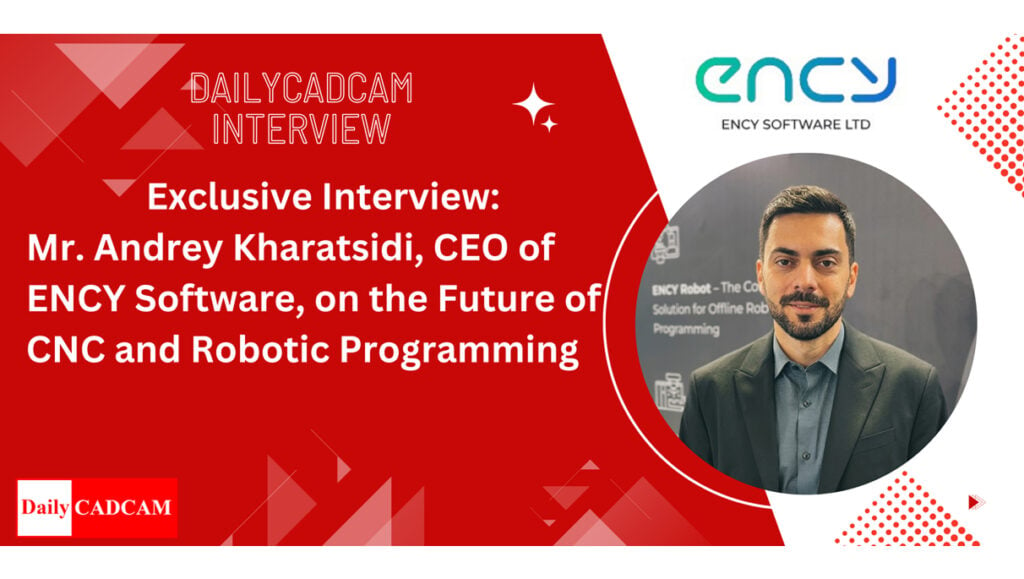
An exclusive interview with Andrei Kharatsidi, CEO of ENCY Software, published by DailyCADCAM after IMTEX 2026, highlights the company’s view of where digital manufacturing is heading next. In the conversation, Andrei outlines ENCY’s technology strategy across CNC programming, robotic programming, simulation, post-processing, and AI — with a strong focus on proprietary development and tightly integrated workflows.
A central point of the interview is ENCY’s commitment to independent technology development. As Andrei says, “We are a fully independent CAM developer, and all core technologies are proprietary.” That includes core components such as toolpath calculation, simulation, 3D model import, and post-processing. This approach gives ENCY direct control over product development, helps accelerate innovation, and enables tighter integration across the software environment.
One of the most concrete parts of the interview focuses on robotic programming. Andrei explains that ENCY Robot enables users to create full digital twins of robotic cells, calculate advanced multi-axis toolpaths, work with complex robot kinematics, and simulate operations before execution. He also points to the range of supported applications, including milling, trimming, welding, painting, and pick-and-place. In parallel, ENCY is advancing ENCY Hyper as a solution that brings together the precision of offline programming and the flexibility of real-time robot control in a single interface.
AI is another major theme. In the interview, Andrei emphasizes that effective AI in manufacturing software must work in context — not as a standalone prompt layer, but as part of the actual CAM project. That means understanding the selected machine, the tooling, and the generated toolpaths. As he puts it, “AI should accelerate workflows, not complicate them.” Among the examples he shares are guided functions such as “Explore this part” and “Suggest next operation,” as well as AI-assisted post-processor customization.
The broader takeaway from the interview is clear: software is no longer just a supporting layer around manufacturing hardware. It is increasingly the element that defines how efficiently that hardware can be used. As Andrei notes, “In today’s manufacturing landscape, software defines productivity.”